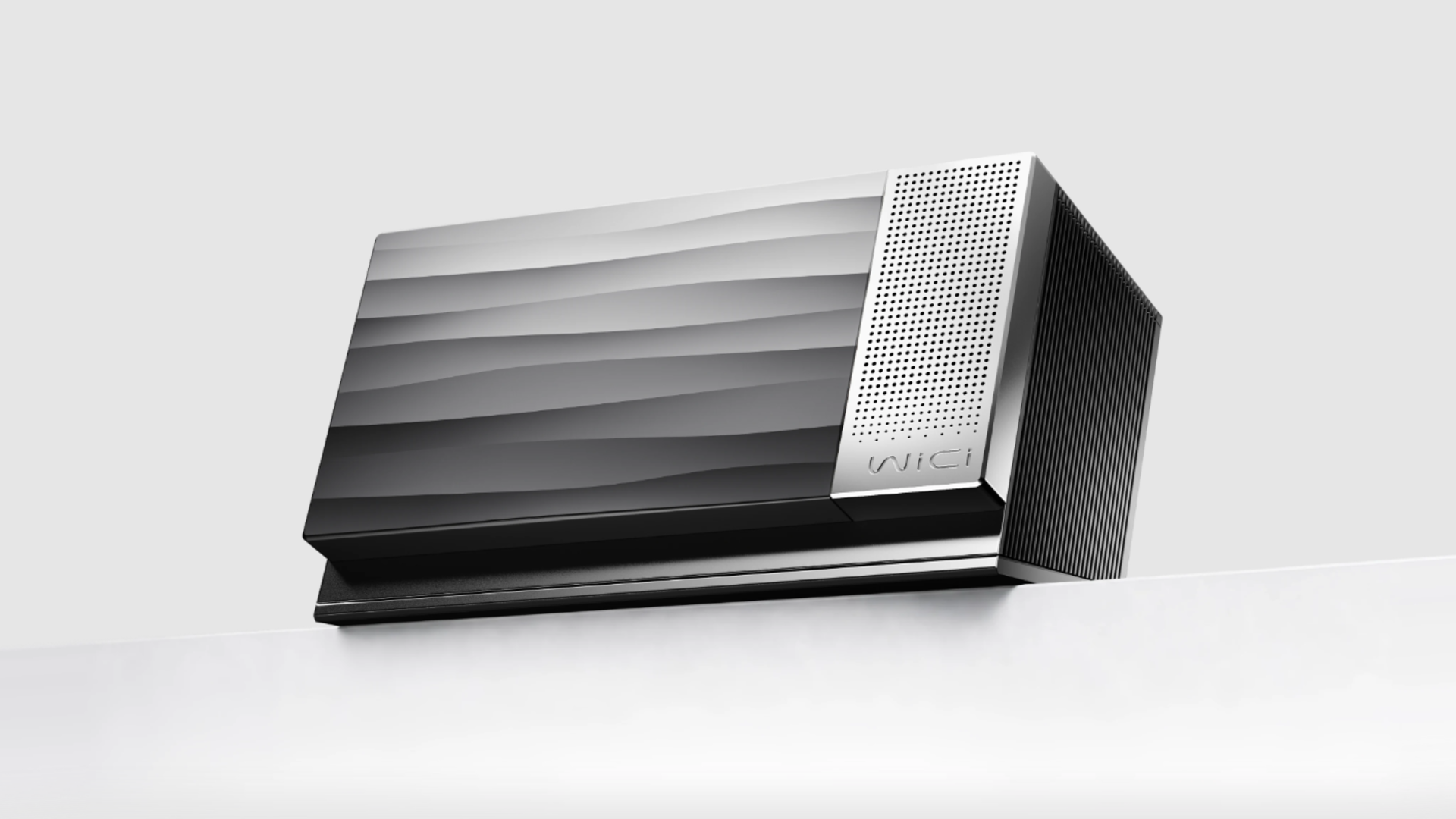
A wireless eGPU is coming soon! WiCi will sell a GeForce RTX 5060 Ti with 16GB GDDR7 that runs through Wi-Fi 7, but you will actually be paying for an entire PC — a local server by any other name
WiCi puts an RTX 5060 Ti inside a complete wireless computer Wi-Fi 7 replaces the cable connecting WiCi's GPU to host devices WiCi's 11.52-Gbps wireless link trails conventional high-speed GPU connections WiCi is preparing a wireless external GPU, the WiCi One, which houses a GeForce RTX 5060 Ti wit
<![CDATA[ <article> <ul><li><strong>WiCi puts an RTX 5060 Ti inside a complete wireless computer</strong></li><li><strong>Wi-Fi 7 replaces the cable connecting WiCi's GPU to host devices</strong></li><li><strong>WiCi's 11.52-Gbps wireless link trails conventional high-speed GPU connections</strong></li></ul><p>WiCi is preparing a wireless external GPU, the WiCi One, which houses a GeForce RTX 5060 Ti with 16GB of GDDR7 memory in a separate box.</p><p>The device communicates through Wi-Fi 7, while its enclosure also contains a <a href="https://www.techradar.com/news/best-processors">processor</a>, storage, power hardware, cooling and networking components.</p><p>The company <a href="https://wici.ai/wici-one" target="_blank" rel="nofollow">says</a> this is not a cloud-style streaming service, although the unit is a full computer with its own processor and storage.</p><h2 id="a-complete-computer-with-a-graphics-processor">A complete computer with a graphics processor</h2><p>The 5060 Ti configuration pairs the <a href="https://www.techradar.com/news/computing-components/graphics-cards/best-graphics-cards-1291458">GPU</a> with an Intel Core 3 100U processor, 1TB NVMe 4 storage, and 16GB GDDR7.</p><p>The device supports Wi-Fi 7 connectivity with 4x4 MIMO and a 320MHz channel, allowing the host device to communicate wirelessly with the separate computer.</p><p>The company also intends to offer an RTX 5090 variant containing 32GB GDDR7, an Intel Core Ultra 7 255H and 4TB NVMe 5 storage.</p><p>WiCi says its software can make the graphics processor available through driver, software development kit and application programming interface modes.</p><p>It describes the arrangement as a local alternative to cloud processing, with data remaining inside the user's network unless deliberately transmitted.</p><p>However, the main question is whether Wi-Fi 7 can provide enough throughput for workloads that normally depend upon much faster wired connections.</p><p>Wi-Fi 7 can theoretically reach 46.1 Gbps under configurations using 16 spatial streams, but WiCi's hardware specifies only four.</p><p>That 4x4 arrangement, using 320MHz bandwidth and 4096-QAM, reaches approximately 11.52 Gbps at the physical layer.</p><p>But its Thunderbolt 5 interface can provide 64 Gbps for PCIe traffic, while PCIe 4.0 x4 through OCuLink also offers 64 Gbps.</p><h2 id="wici-relies-on-software-to-bridge-the-bandwidth-gap">WiCi relies on software to bridge the bandwidth gap</h2><p>WiCi says its protocol reduces network traffic through caching, deduplication, compression, streaming, and pipelining.</p><p>Those techniques are intended to limit how much information must travel between the host and graphics processor during demanding workloads.</p><p>The company claims its RTX 5060 Ti model can run <em>Cyberpunk 2077</em> at 80 FPS in 4K Ultra with DLSS 4.</p><p>It also claims <em>Black Myth: Wukong</em> reaches 60 FPS at 4K Cinematic settings, although independent testing will determine how those results translate in real-life usage.</p><p>WiCi tests place the computer approximately 50 cm from the connected <a href="https://www.techradar.com/news/mobile-computing/laptops/best-laptops-1304361">laptop</a>, leaving questions about performance through walls or amid competing wireless traffic.</p><p>At $1,999 for early signups, WiCi's 5060 Ti model costs considerably more than a conventional external GPU enclosure, although it also includes a processor, storage and other components needed to operate as a standalone computer.</p><p>That makes its comparisons with other compact computing systems more relevant than a simple eGPU price comparison.</p><p>WiCi lists competing pocket AI machines at between $1,399 and $2,999, while Apple's Mac Studio M5 Max starts at $2,499.</p><p>Those systems, however, serve different purposes, since WiCi is designed to place a discrete GPU on the local network and make its computing resources accessible to multiple nearby host devices. </p><figure class="van-image-figure inline-layout" data-bordeaux-image-check ><div class='image-full-width-wrapper'><div class='image-widthsetter' style="max-width:676px;"><p class="vanilla-image-block" style="padding-top:31.51%;"><img id="diM9tpwF2Lz85R8q85CT78" name="tr-g_news" alt="Google logo on a black background next to text reading 'Click to follow TechRadar'" src="https://cdn.mos.cms.futurecdn.net/diM9tpwF2Lz85R8q85CT78-1920-80.jpg" mos="" align="middle" fullscreen="" width="676" height="213" attribution="" endorsement="" class="inline"></p></div></div></figure> </article> ]]>