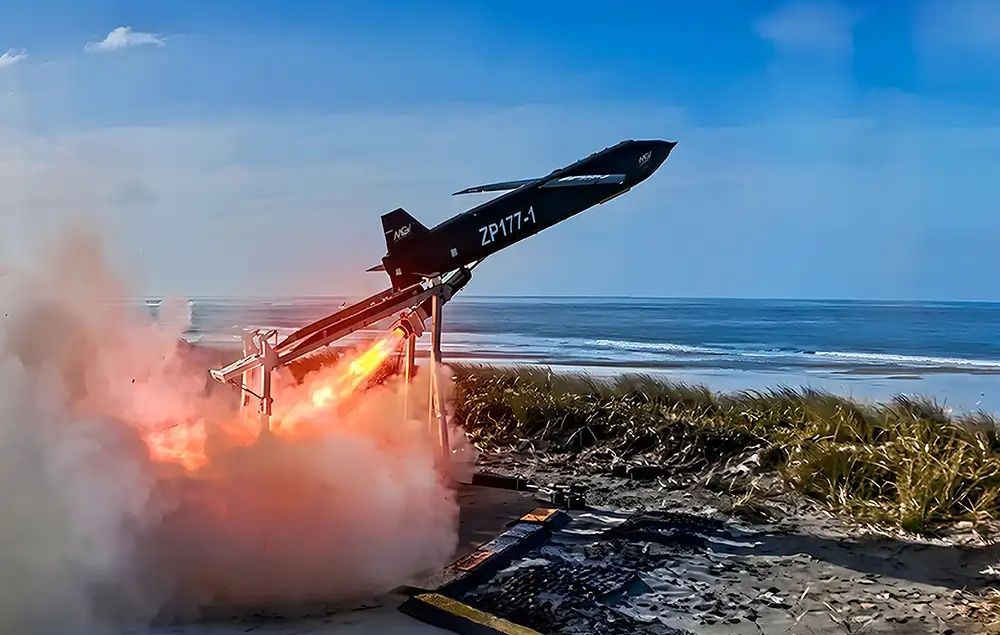
Ex-British F1 engineers build a cheap 466-MPH kamikaze drone
MGI Engineering unveils cruise missile-like drone system, capable of speeds of 466 MPH and designed to operate autonomously in GPS blocked environments The TigerShark can carry a 300 kg payload, with a range of 900 km Parent company MGI Engineering has worked with Formula 1 teams, Formula E cars, an
<![CDATA[ <article> <ul><li><strong>MGI Engineering unveils cruise missile-like drone system, capable of speeds of 466 MPH and designed to operate autonomously in GPS blocked environments</strong></li><li><strong>The TigerShark can carry a 300 kg payload, with a range of 900 km</strong></li><li><strong>Parent company MGI Engineering has worked with Formula 1 teams, Formula E cars, and developed a car that won at the Dakar Rally</strong></li></ul><p>A British engineering company usually associated with Formula 1 and other motorsports has built an affordable “one-way effector” (meaning single-use) strike drone, essentially an intermediate-range cruise missile. MGI Engineering’s TigerShark is deployed from a ground-based vehicle with a rocket-assisted launch, whereby its onboard propulsion takes over and the rocket is detached.</p><p>Capable of delivering a 300-kilogram payload, the TigerShark uses GPS for navigation but is also designed to reach its target in terrain where GPS is unavailable or jammed.</p><p>The TigerShark is intended to be launched in multiples, with a swarm of the drones intended to attack targets, aiming to overwhelm air defense systems.</p><h2 id="complementary-technologies">Complementary technologies</h2><p>Based in Witney in Oxfordshire, <a href="https://mgidefence.co.uk/" target="_blank">MGI Defence</a> — part of MGI Engineering — first unveiled the TigerShark at the DSEI exhibition in 2025. It now aims to bring the TigerShark to market within months, aiming to sell it to Britain’s strategic allies as a drone-based alternative to traditional cruise missiles. </p><p>Designed for faster assembly and delivery, the TigerShark can solve the problem of shrinking defense budgets, too, costing far less than Storm Shadow or Tomahawk cruise missiles. </p><p>As a one-way effector, the single-use drone is designed with a rocket-assisted propulsion for launch while twin turbojet engines drive the 661-pound payload to its target up to 900 kilometers (559 miles) away. Reaching speeds of up to 750 km/h (466 mph), the TigerShark can operate despite GPS jamming, thanks to inertial navigation.</p><p>This is one aspect of a pair of technologies used in conjunction to assure GPS-free targeting. While inertial navigation tracks position based on motion and speed from the launch point, a terrain-mapping system ensures what the TigerShark sees below matches its intended route, and makes adjustments. So, even if GPS is jammed, the TigerShark should reach its target.</p><h2 id="land-based-salvo">Land-based salvo</h2><p>MGI has announced that the drone is available from October 2026, and will be manufactured in the UK with export licenses to friendly countries. </p><p>The company states that “TigerShark enables defence forces to engage defended or distant targets with speed, precision, and autonomy, without relying on satellite navigation or real-time control. Its guidance suite combines inertial navigation with GPS-free terrain mapping for reliable operation in GPS-denied and spoofed environments.”</p><p>“Built for coordinated launch and rapid deployment, TigerShark can be fired as a salvo from a land-based vehicle launcher to overwhelm or degrade enemy defences. Its modular payload bay supports a wide range of mission types, from warhead delivery to electronic disruption.”</p><p>The TigerShark will enter increased production in late 2026, with MGI Defence aiming to sell to allies needing a more affordable and faster acquisition alternative to traditional intermediate-range cruise missiles.</p> </article> ]]>
Read the full article on TechRadar
Read Full Article →