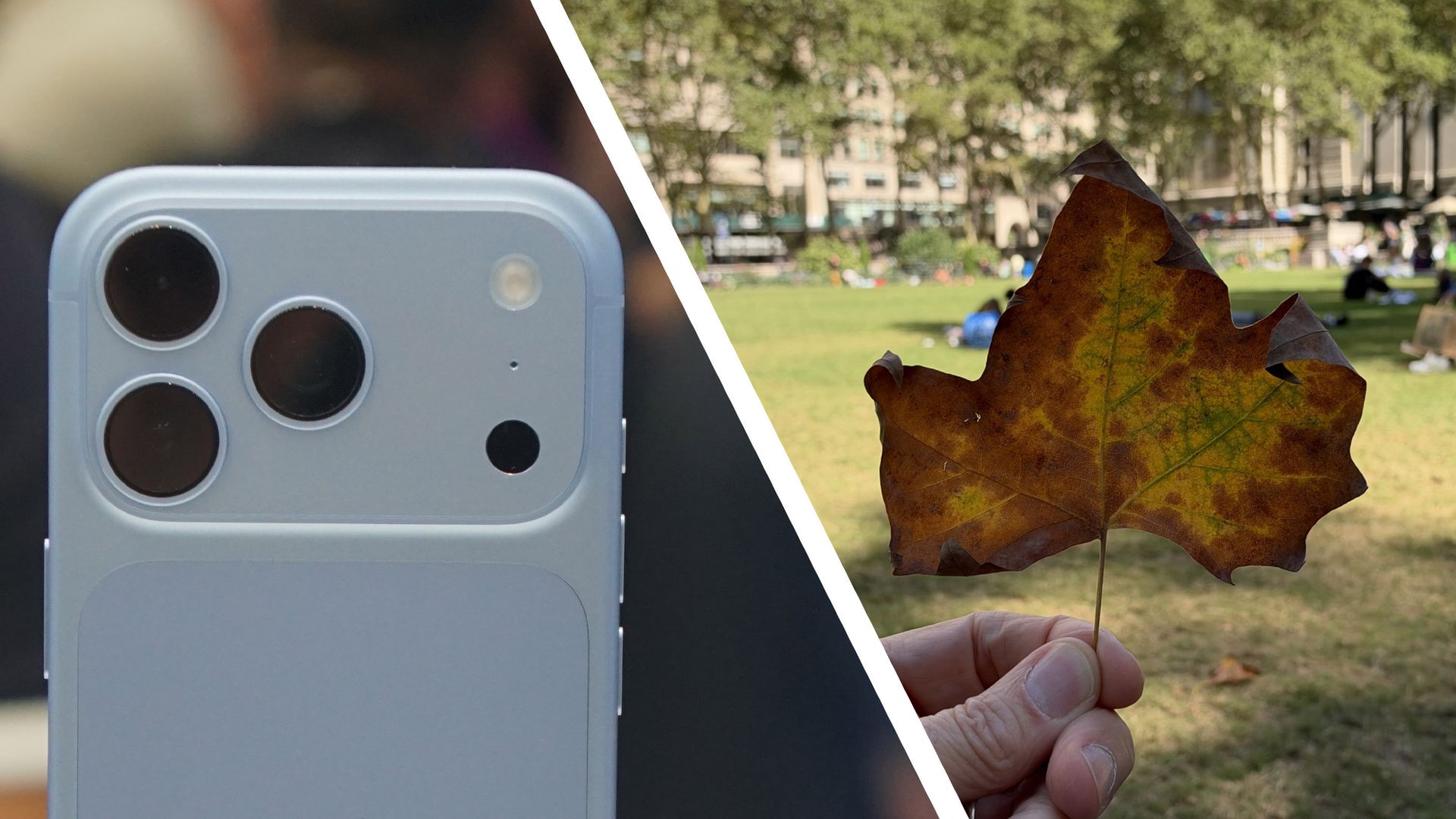
It took exactly one photo for me to realize the awesome power of the iPhone 18 Pro's variable aperture
The iPhone 18 Pro Max main camera's new variable aperture is a huge deal and, in my limited experience, I can already see that it could transform iPhone photography.
<![CDATA[ <article> <p>The iPhone 18 Pro Max main camera's new variable aperture is a huge deal and, in my limited experience, I can already see that it could transform iPhone photography. Still, to know why this matters, you need to understand how it works.</p><p>The best analogy is your eyes.</p><p>If you've ever squinted to read something, you understand how an aperture works. The more open your pupil, the more light that comes in, but it's widely scattered, making objects in the distance out of focus. If you squint, that cuts the amount of light coming into your eye, but it also removes more of the scattered light, leaving only the sharper light and imagery. On a camera, the open aperture (represented by lower f-stop numbers) has the same effect as your wide-open pupils. Lots more light, but only stuff nearest you is in focus. A smaller aperture, represented by higher f-stop numbers, is the eye-squint: less light but more focus throughout the frame.</p><p>Ever since Apple announced the <a href="https://www.techradar.com/phones/iphone/iphone-18-pro-and-iphone-18-pro-max-review">iPhone 18 Pro</a> (and Pro Max's) big camera update, which also includes voluminous Pro-level controls, I've been itching to try them. As soon as I got my iPhone 18 Pro Max in black, I ran outside to see if the update makes an appreciable difference in photography quality and possibilities.</p><p>The short answer is yes.</p><h2 id="understanding-this-new-variable-aperture">Understanding this new variable aperture</h2><p>A few things you should know about this new hardware feature. First, it's only on the 48MP main lens, so the 48MP, 4x telephoto, and 48MP ultrawide cameras only have fixed apertures: ƒ/2.8 and ƒ/2.2, respectively. Those are decently wide apertures, but the Main camera has Auto, ƒ/1.48, ƒ/1.8, ƒ/2.8, ƒ/4.0. That's a wide range. It's not quite DSLR-level, where you can stop down to, say, ƒ/11, which can be useful for deep focus and for capturing ultra-bright objects like the moon at night.</p><p>It's also worth noting that these are physical f-stops. The iPhone 18 Pro Max Main camera aperture features an array of interlocked blades thinner than a human hair, and they slide over each other as the aperture opens and closes. It's an engineering marvel. In the right light, you can see them adjusting.</p><p>I think it's fair to wonder why we need a physical, variable aperture when many of the iPhones since the <a href="https://www.techradar.com/reviews/phones/mobile-phones/iphone-7-plus-1327948/review/5">iPhone 7 Plus</a> have included portrait mode technology. In the early days, it used information from its wide and telephoto lenses to craft a bokeh effect. Eventually, Apple started using software to analyse the image and create a portrait mode with just a single lens (see <a href="https://www.techradar.com/reviews/iphone-se">2020's iPhone SE</a>). No matter how the iPhones have done it over the years, it's impressive and, for most users, good enough.</p><figure class="van-image-figure inline-layout" data-bordeaux-image-check ><div class='image-full-width-wrapper'><div class='image-widthsetter' style="max-width:2560px;"><p class="vanilla-image-block" style="padding-top:56.25%;"><img id="NyJLbMZhUHKPaQza65Pb4n" name="Apple iPhone 18 Pro and iPhone 18 Pro Max Hands-On" alt="Apple iPhone 18 Pro and iPhone 18 Pro Max Hands-On" src="https://cdn.mos.cms.futurecdn.net/NyJLbMZhUHKPaQza65Pb4n-1920-80.jpg" mos="" align="middle" fullscreen="" width="2560" height="1440" attribution="" endorsement="" class="inline"></p></div></div><figcaption itemprop="caption description" class=" inline-layout"><span class="credit" itemprop="copyrightHolder">(Image credit: Jacob Krol/Future)</span></figcaption></figure><p>My goal, though, was to see how the portrait mode on the iPhone 18 Pro Max might differ from variable aperture photography (my preferred setting was f1.48). In other words, software vs. hardware. I did also fiddle with the other f-stops, but in bright daylight, the bokeh effect on ƒ/1.8 and ƒ/2.8 is quite subtle.</p><p>I took pictures of myself, photos of statues, and the image above of a drying leaf. That photo, or rather that one compared to the Portrait Mode shot of the same leaf, is what convinced me: this is a game changer.</p><p>When you use Portrait Mode on an iPhone, you can adjust the bokeh before or after photography. It's a reminder that this is, at least in part, a software effect that can include or discard as much background sharpness as you desire.</p><figure role="gallery"><figure><img src="https://cdn.mos.cms.futurecdn.net/oDrpKSxLXdLDV5sFzZsJZ-1920-80.jpg" alt="iPhone 18 Pro Max variable aperture test" /><figcaption>iPhone 18 Pro Max variable aperture<small role="credit">Lance Ulanoff</small></figcaption></figure><figure><img src="https://cdn.mos.cms.futurecdn.net/yRobpMRcyXGFXx438ogvCo-1920-80.jpg" alt="iPhone 18 Pro Max variable aperture test" /><figcaption>Portrait mode<small role="credit">Lance Ulanoff</small></figcaption></figure></figure><h2 id="a-new-leaf">A new leaf</h2><p>Using the variable aperture is more akin to traditional photography. You have the lens, the aperture settings, and, now, if you choose, shutter speed, exposure, and focus. In the initial images, I left everything alone except for the aperture. To access it, you select the grid menu in the camera app, choose Aperture, and then select the aperture opening of your choice.</p><figure role="gallery"><figure><img src="https://cdn.mos.cms.futurecdn.net/kFJXvKQ4FfCnLngqdyfS6-1920-80.jpg" alt="iPhone 18 Pro Max variable aperture test" /><figcaption>iPhone 18 Pro Max variable aperture<small role="credit">Lance Ulanoff</small></figcaption></figure><figure><img src="https://cdn.mos.cms.futurecdn.net/9pG8tr5y38iECQ9RH273Bo-1920-80.jpg" alt="iPhone 18 Pro Max variable aperture test" /><figcaption>Portrait mode<small role="credit">Lance Ulanoff</small></figcaption></figure></figure><p>I chose f1.48 and snapped a photo of the same leaf.</p><p>The result, which you can see above, was two pretty good pictures, but closer examination reveals how Portrait Mode struggled with the curling leaf. Look at the stem. It's almost gone. By contrast, on the variable aperture shot, it was clear that the phone wasn't trying to apply some software magic to separate the leaf from the background and create the bokeh. The leaf is complete. The whole image looks natural and, honestly, the hardware does what it would do on a traditional camera: let the lens and aperture opening make the call. </p><p>The leaf is in stark, colorful focus, and the background, while not as blurred as you get from Portrait Mode's default settings, is pleasantly out of focus.</p><figure role="gallery"><figure><img src="https://cdn.mos.cms.futurecdn.net/WEsvwSmx7Uo5zW5zyJp7b-1920-80.jpg" alt="iPhone 18 Pro Max variable aperture test" /><figcaption>iPhone 18 Pro Max variable aperture<small role="credit">Lance Ulanoff</small></figcaption></figure><figure><img src="https://cdn.mos.cms.futurecdn.net/4FXVdLJynRBQw963q4gEUo-1920-80.jpg" alt="iPhone 18 Pro Max variable aperture test" /><figcaption>Portrait mode<small role="credit">Lance Ulanoff</small></figcaption></figure></figure><p>I saw similar results with my selfies. Again, Portrait Mode goes hard on the background blur, but because it's largely computational, some artifacts remain. In particular, the space between the right stem of my glasses and my head is oddly sharp. And, if I'm being honest, the default level of bokeh sort of disconnects me from the background environment.</p><p>The results on the Gertrude Stein statue are less equivocal. The default portrait mode seems to favor the figure a bit more, though I still like the variable apertures' more realistic background blur.</p><h2 id="let-39-s-go-pro">Let's go Pro</h2><p>Later, I started fiddling with a combination of aperture settings, shutter speeds, exposures, and focus. There are limits on all of these tools, but that's really the limitation of a smartphone camera. Without the really big sensor, wider space between the lens, aperture, shutter, and sensor, there's only so much you can do.</p><p>Still, I was impressed. My variable aperture shots look closer than ever to pro-level photography, and the additional pro controls are just so much fun to play with. </p><figure role="gallery"><figure><img src="https://cdn.mos.cms.futurecdn.net/ZTtRswntJTvRnfWYpYe4e-1920-80.jpg" alt="iPhone 18 Pro Max variable aperture test" /><figcaption>For this black and white style image, I adjusted the shutter speed to 1/223s with f1.8<small role="credit">Lance Ulanoff</small></figcaption></figure><figure><img src="https://cdn.mos.cms.futurecdn.net/VEBjARm6EY2L9YCBGywzf-1920-80.jpg" alt="iPhone 18 Pro Max variable aperture test" /><figcaption>Here, the shutter speed is just 1/121s with f2.8<small role="credit">Lance Ulanoff</small></figcaption></figure><figure><img src="https://cdn.mos.cms.futurecdn.net/MFrKmQQm5jLedqNJjaxKf-1920-80.jpg" alt="iPhone 18 Pro Max variable aperture test" /><figcaption>shutter speed 1/602s at f1.8<small role="credit">Lance Ulanoff</small></figcaption></figure><figure><img src="https://cdn.mos.cms.futurecdn.net/kQLRdhMWR944UTnw8DF3e-1920-80.jpg" alt="iPhone 18 Pro Max variable aperture test" /><figcaption>F2.2 at a slow 1/60s.<small role="credit">Lance Ulanoff</small></figcaption></figure><figure><img src="https://cdn.mos.cms.futurecdn.net/uhJyisq5EyEmme4d9ENa-1920-80.jpg" alt="iPhone 18 Pro Max variable aperture test" /><figcaption>This is a high-speed shot (1/2088s) at f1.48.<small role="credit">Lance Ulanoff</small></figcaption></figure><figure><img src="https://cdn.mos.cms.futurecdn.net/y2n9gKyEYu5AdT4E5yy6X-1920-80.jpg" alt="iPhone 18 Pro Max variable aperture test" /><figcaption>Even though there was a lot of shadow, I used the Pro settings to push this to 1/693s with an f1.48 aperture.<small role="credit">Lance Ulanoff</small></figcaption></figure><figure><img src="https://cdn.mos.cms.futurecdn.net/vGTrMwnJmnVj3xxKeQeyb-1920-80.jpg" alt="iPhone 18 Pro Max variable aperture test" /><figcaption>F1.48s with high shutter speed (1/14286s).<small role="credit">Lance Ulanoff</small></figcaption></figure></figure><p>If there's any disappointment here, it's that we have just one variable aperture. I could do amazing things with more f-stops on the telephoto lens. Ah well, there's always next year.</p><p>Check out my gallery to see some of what I shot on my first day with the iPhone 18 Pro Max.</p><div data-widget-type="merchantlink" data-model-name="Apple iPhone 18 Pro,Apple iPhone 18 Pro Max"></div> </article> ]]>
Read the full article on TechRadar
Read Full Article →