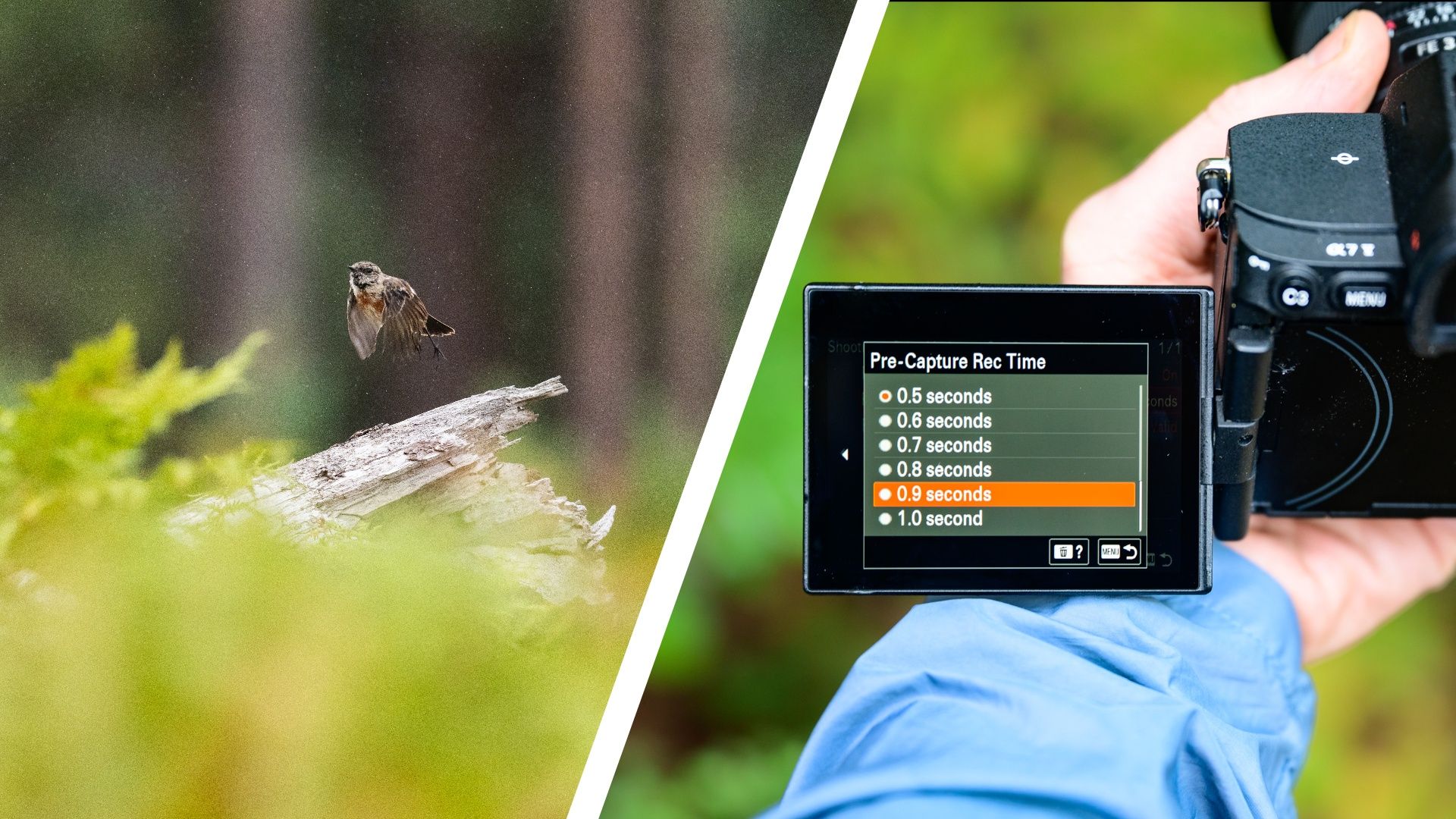
Pre-capture is the best wildlife photography trick you’re not using — here’s how I use the handy tool and which Canon, Nikon and Sony cameras support it
If you followed the release of the new Canon EOS R8 Mark II, you might be wondering what the feature pre-continuous shooting is, otherwise known as pre-capture (Sony and Nikon), Pro Capture (OM System), Pre-Burst (Panasonic) or Pre-shot ES (Fujifilm).
<![CDATA[ <article> <p>If you followed the release of the new <a href="https://www.techradar.com/cameras/mirrorless-cameras/canon-eos-r8-mark-ii-review">Canon EOS R8 Mark II,</a> you might be wondering what the feature pre-continuous shooting is, otherwise known as pre-capture (Sony and Nikon), Pro Capture (OM System), Pre-Burst (Panasonic) or Pre-shot ES (Fujifilm). </p><p>The feature has been around for a while now having been introduced by OM System (Olympus), and it’s slowly worked its way across brands and into affordable models, including the R8 II, Sony A7 V and Nikon Z5 II. </p><p>I'm here to explain pre-capture, and show you the benefit of this feature with images I wouldn’t have otherwise been able to capture without it. Let’s dive in. </p><h2 id="what-is-pre-capture-and-how-does-it-work">What is pre-capture and how does it work?</h2><p>Picture this — you’ve got your camera fixed on a subject, poised for the action to happen; athletes on the 100m start line, a kingfisher on a branch that could take flight at any moment, a potential goal in a soccer match. </p><p>Sometimes your reactions aren’t up to speed to capture the key moment, and it's gone before your finger has pressed the shutter button. It’s exactly these scenarios that pre-capture is designed for, and it's the feature that helped me get the images of birds in flight, where previously I’d have missed the moment or simply settled for ones of them perched on branches. </p><p>Pre-capture gives you up to a 1 second head start (depending on the model) before the shutter is pressed, continually shooting (to a temporary buffer) before you press the shutter button, at which point the images shot in the specified time before the shutter button was fully pressed are recorded retrospectively.</p><figure class="van-image-figure inline-layout" data-bordeaux-image-check ><div class='image-full-width-wrapper'><div class='image-widthsetter' style="max-width:2500px;"><p class="vanilla-image-block" style="padding-top:66.68%;"><img id="mkHMgaqGEi4VyGWgWvv3Dg" name="Pre capture feature sample" alt="An empty branch in a nature reserve" src="https://cdn.mos.cms.futurecdn.net/mkHMgaqGEi4VyGWgWvv3Dg-1920-80.jpg" mos="" align="middle" fullscreen="" width="2500" height="1667" attribution="" endorsement="" class="inline"></p></div></div><figcaption itemprop="caption description" class=" inline-layout"><span class="caption-text">What would've happened without pre capture </span><span class="credit" itemprop="copyrightHolder">(Image credit: Tim Coleman)</span></figcaption></figure><p>With pre-capture on, it's typically initiated by half pressing the shutter button (or fully pressing an assignable button, such as the autofocus button), as is the case with the <a href="https://www.techradar.com/cameras/sony-a7-v-review">Sony A7 V</a> I used to take the pictures in this feature. </p><p>The Canon EOS R8 Mark II, for example, can shoot up to 40fps and offers up to 0.5 second pre-capture, meaning you can retrospectively record a 20 photo sequence in the half second before you press the shutter button. The Sony A7 V can shoot up to 30fps with up to 1 second pre-capture, so that’s up to 15 images.</p><figure class="van-image-figure inline-layout" data-bordeaux-image-check ><div class='image-full-width-wrapper'><div class='image-widthsetter' style="max-width:2500px;"><p class="vanilla-image-block" style="padding-top:56.28%;"><img id="yXcB5Jnrk8Z2H5QLafoakb" name="Pre-capture-GIF-1" alt="GIF of a small bird taking flight from a branch in a nature reserve" src="https://cdn.mos.cms.futurecdn.net/yXcB5Jnrk8Z2H5QLafoakb-1920-80.gif" mos="" align="middle" fullscreen="" width="2500" height="1407" attribution="" endorsement="" class="inline"></p></div></div><figcaption itemprop="caption description" class=" inline-layout"><span class="credit" itemprop="copyrightHolder">(Image credit: Tim Coleman)</span></figcaption></figure><h2 id="how-to-use-pre-capture-effectively">How to use pre-capture effectively</h2><p>I recently got into bird photography and it didn’t take me long to bag some beautiful photos of the varied birdlife in my local nature reserve and wetland, using some superb review gear — including <a href="https://www.techradar.com/cameras/camera-lenses/i-tried-bird-photography-with-sonys-longest-super-telephoto-zoom-lens-and-the-new-a7r-vi-and-after-seeing-my-pin-sharp-shots-of-rare-and-beautiful-birds-im-obsessed">the Sony 400-800mm F6.3-8 super telephoto zoom lens</a>. </p><p>As enjoyable as this hobby is (and it really is), soon enough I was considering how I could mix up the kind of photos I was making, besides stationary birds on branches. Pre-capture came to mind. How about capturing photos of the birds taking flight?</p><p>Birds in flight is one of the toughest photography challenges — as I found out during a recent hands-on with the <a href="https://www.techradar.com/cameras/camera-lenses/i-photographed-birds-of-prey-in-flight-with-fujifilms-new-400mm-f-4-5-super-telephoto-prime-lens-and-it-proved-the-x-series-is-no-wildlife-slouch-compared-to-sony-and-canon">Fujifilm XF 400mm F4.5 R LM WR lens at a birds of prey experience</a>. And that was when I had some idea of where the birds would be flying. But wild birds in flight? Nigh on impossible, I thought. </p><p>I chose the most appropriate autofocus mode (in this case bird subject detection), the continuous high drive mode (30fps), set a suitably fast shutter speed to freeze movement (1/1000sec, wasn't fast enough it turned out) and, of course, activated pre-capture. I started with the maximum time possible of 1 second, though the camera in question has options from 0.1 sec to 1 sec in full decimal points. </p><figure class="van-image-figure inline-layout" data-bordeaux-image-check ><div class='image-full-width-wrapper'><div class='image-widthsetter' style="max-width:2000px;"><p class="vanilla-image-block" style="padding-top:56.30%;"><img id="UDqffA8tLDdDXLgdXYETnD" name="Pre-capture-GIF 2" alt="GIF of a small bird taking flight from a fallen tree that's emerging from a bed of ferns" src="https://cdn.mos.cms.futurecdn.net/UDqffA8tLDdDXLgdXYETnD-1920-80.gif" mos="" align="middle" fullscreen="" width="2000" height="1126" attribution="" endorsement="" class="inline"></p></div></div><figcaption itemprop="caption description" class=" inline-layout"><span class="credit" itemprop="copyrightHolder">(Image credit: Tim Coleman)</span></figcaption></figure><p>Pre-capture helped me get the shots you see in this article, but there were a couple more non-technical ingredients in the recipe: an eye for the shot and, ultimately, patience. </p><p>Once I had the composition and subject I liked, I kept the camera locked in with the shutter half pressed and waited for the bird to take flight. Many times the bird was content for several minutes, and I could feel my finger / thumb burning by the time it moved.</p><p>On my first attempt I thought I had missed the moment even with pre-capture active, but low and behold my slow reactions were redeemed. </p><p>I think my patience has paid off. Yes, the photos of the birds stationary are still lovely, but the ones of them in flight in an already well-composed scene take them to new heights. </p><p>There are plenty of other scenarios that benefit from pre-capture, and if you’re a keen sports or wildlife photographer it’s well worth trying out — I’ve included a list of recent cameras equipped with the feature, plus shopping links, below.</p><figure role="gallery"><figure><img src="https://cdn.mos.cms.futurecdn.net/dK78n3cCtxVLgMnBgbqYjW-1920-80.jpg" alt="A small bird taking flight from a branch in a nature reserve" /><figcaption><small role="credit">Tim Coleman</small></figcaption></figure><figure><img src="https://cdn.mos.cms.futurecdn.net/KYTvuyqXtnNVQuo9VT8bfW-1920-80.jpg" alt="A small bird taking flight from a branch in a nature reserve" /><figcaption><small role="credit">Tim Coleman</small></figcaption></figure><figure><img src="https://cdn.mos.cms.futurecdn.net/e87fC2bf4FWaMDq46aeXaW-1920-80.jpg" alt="A small bird taking flight from a branch in a nature reserve" /><figcaption><small role="credit">Tim Coleman</small></figcaption></figure></figure><h2 id="cameras-with-pre-capture">Cameras with pre-capture</h2><p>The following cameras are listed as having each company's version of pre-capture: </p><ul><li>Canon EOS R1, EOS R5 Mark II, EOS R6 Mark II, EOS R6 Mark III, EOS R8 Mark II</li><li>Nikon Z9, Nikon Z8, Nikon Z6 III, Nikon Z5 II, Nikon Z50 II</li><li>Sony A9 III, Sony A1 II, Sony A7R VI, Sony A7 V</li><li>OM System OM-1, OM1 Mark-II, OM-5 Mark II, Olympus OM-D E-M1 X, E-M1 Mark III, E-M1 Mark II, E-M5 Mark III, Tough TG-6, Tough TG-7</li><li>Panasonic Lumix G9, Lumix G9 II, Lumix S5 II / X, Lumix S1 II, Lumix S1 II R</li><li>Fujifilm X-T5, X-T4, X-T3, X-T30 III, X-T30 II, X-T30, X-H2S, X-H2, X-Pro3, X100VI</li></ul><div data-widget-type="multimodelreview" data-model-name="Canon EOS R8 Mark II,Sony A7 V,Nikon Z5 II,OM System OM-1 II,Panasonic Lumix G9 II"></div> </article> ]]>
Read the full article on TechRadar
Read Full Article →