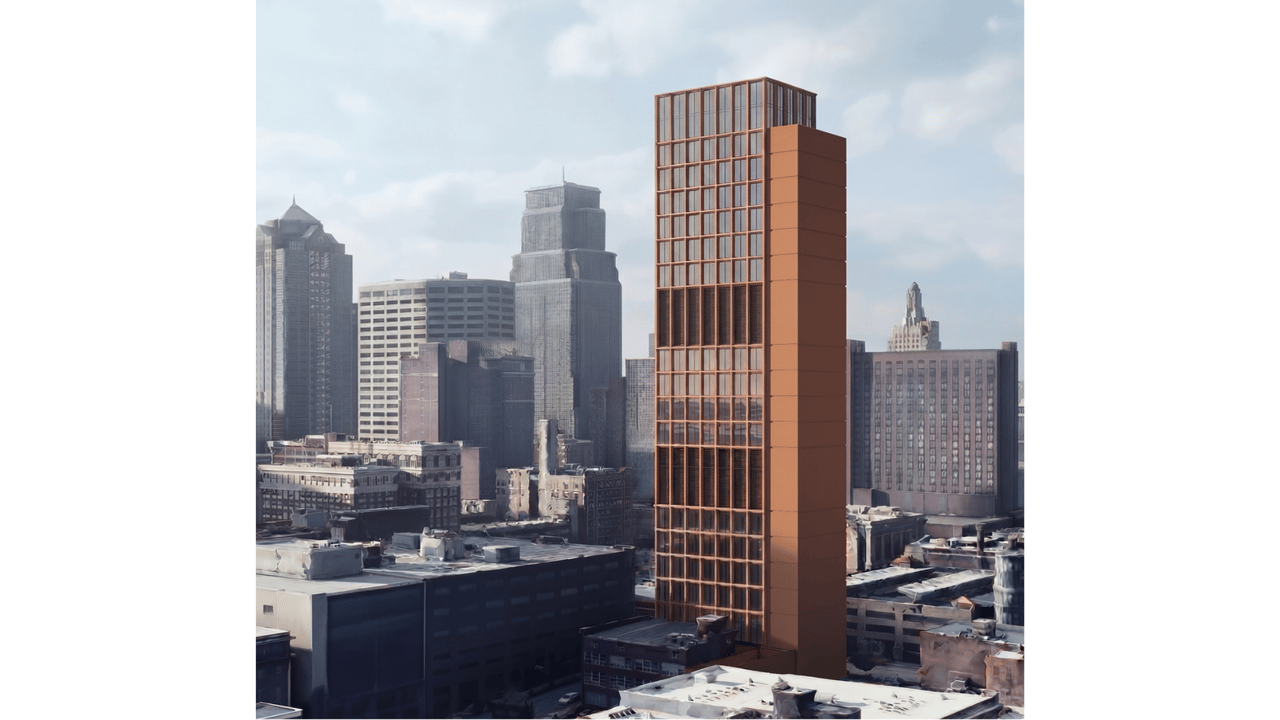
'This data center belongs downtown': Developer proposes 20-story vertical data center in Kansas City to trade suburban sprawl for urban density
Kansas City developer proposes 20-story data center on only 0.23 acres Only two floors of Revitalization Unlimited's 20-story tower would house servers The vertical data center would cost $183 million — $1,300 per square foot Recent research from real estate firm Cushman & Wakefield claims the avera
<![CDATA[ <article> <ul><li><strong>Kansas City developer proposes 20-story data center on only 0.23 acres</strong></li><li><strong>Only two floors of Revitalization Unlimited's 20-story tower would house servers</strong></li><li><strong>The vertical data center would cost $183 million — $1,300 per square foot</strong></li></ul><p>Recent research from real estate firm Cushman & Wakefield claims the average data center land transaction covers 224 acres, pushing many projects away from urban centers toward larger sites.</p><p>Revitalization Unlimited has a different idea: instead of spreading facilities across larger cities, why not build upward within the city?</p><p>The developer has proposed a 20-story facility in central Kansas City that would concentrate computing equipment and supporting infrastructure on approximately 0.23 acres.</p><h2 id="power-and-cooling-take-most-of-the-space">Power and cooling take most of the space</h2><p>The proposed tower would provide 24 MW of IT capacity, but only two of its 20 levels would contain computing equipment; 18 floors accommodate power and cooling.</p><p>Approximately 109,000 square feet of the building’s 141,000 gross square feet would instead accommodate mechanical systems and related infrastructure.</p><p>This arrangement could provide dense connectivity while avoiding the land requirements associated with conventional suburban campuses.</p><p>Revitalization Unlimited argues that the vertical <a href="https://www.techradar.com/pro/best-data-center-proxies">data center</a> is important because some computing workloads benefit from being physically closer to users and networks.</p><p>"We are not arguing that every data center belongs downtown. We are arguing this one does, and we are paying a construction premium to prove it," says Steve Austin, founder and CEO of Revitalization Unlimited.</p><p>For some inference services, shorter distances between computing resources and users can reduce delays during interactions requiring rapid responses.</p><p>Financial trading can also justify exceptionally close network locations because tiny timing differences can matter.</p><p>“It is not uncommon for stock traders to seek addresses closest to the actual stock exchange servers where transactions are processed in order to gain a few fractions of a second in any given transaction,” Luis Fernandes, IDC senior research manager.</p><p>Generally, finance, telecommunications, content delivery, and inference are workloads that could potentially make dense urban sites useful.</p><p>Large AI training operations, however, generally require substantial land and electricity, making conventional sites more suitable for those deployments.</p><h2 id="higher-construction-costs-test-the-urban-case">Higher construction costs test the urban case</h2><p>The total development cost for this project is $183 million, equivalent to about $1,300 per square foot, exceeding typical suburban construction economics.</p><p>Mechanical, electrical, plumbing, and fire protection systems would account for about $107 million of the estimated $167 million in hard construction costs.</p><p>The facility would seek a PUE of 1.25 and rely on 30 MW of Bloom fuel cells for primary power generation.</p><p>Natural gas would form part of the operating expense, meaning onsite generation would not eliminate fuel consumption or related environmental considerations.</p><p>Cooling would also involve evaporative equipment, complicating descriptions suggesting that water use could be eliminated through a closed-loop arrangement.</p><p>Vertical construction can create difficulties involving equipment weight, elevator capacity, and crane access.</p><p>This could increase the overall construction cost and also complicate replacement logistics during future maintenance work.</p><p>The vertical data center, designed by Skidmore, Owings & Merrill (SOM), remains subject to approval, with a related development ordinance currently listed as pending until October 13 2026. </p><p>Via <a href="https://www.datacenterknowledge.com/data-center-site-selection/vertical-data-centers-face-cost-proximity-trade-offs" target="_blank" rel="nofollow">Data Center Knowledge</a></p><figure class="van-image-figure inline-layout" data-bordeaux-image-check ><div class='image-full-width-wrapper'><div class='image-widthsetter' style="max-width:676px;"><p class="vanilla-image-block" style="padding-top:31.51%;"><img id="diM9tpwF2Lz85R8q85CT78" name="tr-g_news" alt="Google logo on a black background next to text reading 'Click to follow TechRadar'" src="https://cdn.mos.cms.futurecdn.net/diM9tpwF2Lz85R8q85CT78-1920-80.jpg" mos="" align="middle" fullscreen="" width="676" height="213" attribution="" endorsement="" class="inline"></p></div></div></figure> </article> ]]>
Read the full article on TechRadar
Read Full Article →