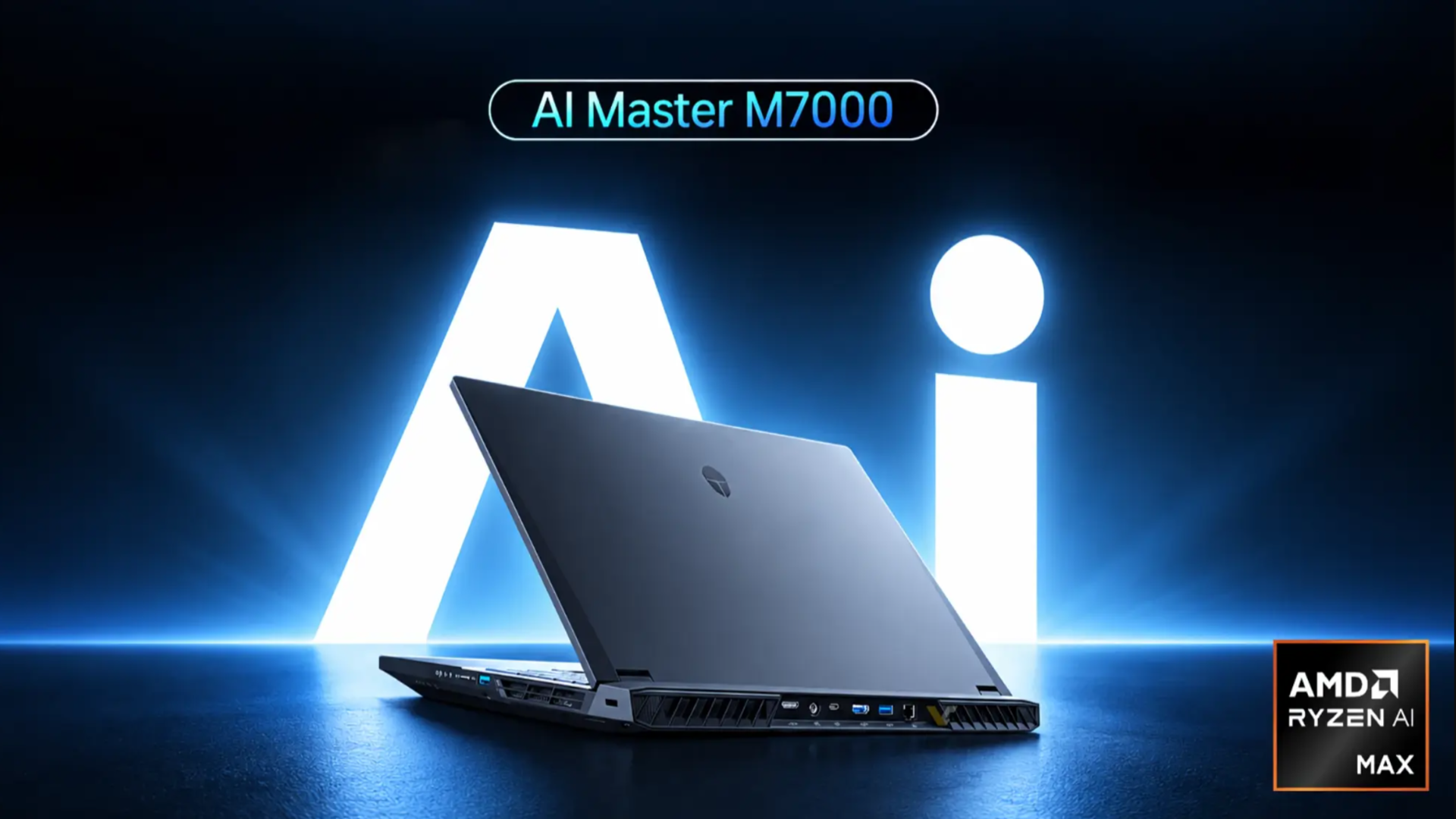
Thunderobot just launched a laptop that uses a special RAM-like SSD to boost AI performance — AI Master M7000 packs Ryzen AI Max+ 395 with 64GB RAM, runs 120B MoE models
Thunderobot uses SSD storage to help its 64GB laptop run huge AI models The M7000 can reportedly run GPT-OSS-120B despite having 64GB of memory Phison's aiDAPTIV+ technology turns part of the SSD into an AI cache Thunderobot has released the AI Master M7000, a 16-inch mobile workstation built around
<![CDATA[ <article> <ul><li><strong>Thunderobot uses SSD storage to help its 64GB laptop run huge AI models</strong></li><li><strong>The M7000 can reportedly run GPT-OSS-120B despite having 64GB of memory</strong></li><li><strong>Phison's aiDAPTIV+ technology turns part of the SSD into an AI cache</strong></li></ul><p>Thunderobot has released the AI Master M7000, a 16-inch mobile <a href="https://www.techradar.com/best/best-workstations">workstation</a> built around AMD's Ryzen AI Max+ 395 processor.</p><p>The M7000 comes with 64GB of LPDDR5X-8000 memory and Radeon 8060S integrated graphics for demanding workloads.</p><p>Its 768GB drive incorporates an 85GB caching layer designed to help AI workloads handle models exceeding available system memory.</p><h2 id="ai-workloads-get-an-unusual-storage-assist">AI workloads get an unusual storage assist</h2><p>The M7000 uses LPDDR5X-8000 memory, while its <a href="https://www.techradar.com/news/best-processors">processor</a> provides 16 cores, 32 threads, boost speeds reaching 5.1GHz, and an XDNA 2 neural processor.</p><p>AMD rates the neural hardware at 50 TOPS, while the Radeon 8060S configuration reaches as many as 40 compute units for graphics and accelerated workloads.</p><p>Thunderobot says the device can run GPT-OSS-120B locally, despite having 64GB of physical memory available for applications and operating-system requirements.</p><p>Its unified memory architecture allows processor and graphics resources to access shared memory, supporting workloads that frequently move substantial model data.</p><p>The additional cache comes from Phison’s aiDAPTIV+ technology, which uses part of the internal storage to hold data associated with artificial intelligence workloads.</p><p>Rather than functioning as conventional RAM, this arrangement keeps selected information on the <a href="https://www.techradar.com/news/best-solid-state-drives-ssds">SSD</a> when unified memory capacity becomes restrictive during demanding workloads.</p><p>Such information can include Key-Value cache, less-active mixture-of-experts components, and model data that applications may require again during processing.</p><p>Phison has also shown this storage approach with computers carrying considerably less memory, including a 32GB laptop running the same 120B model.</p><p>The technology addresses a limitation faced by large local models, where available memory can restrict the performance of certain workloads. </p><h2 id="a-160w-mobile-workstation-with-unusually-high-specifications">A 160W mobile workstation with unusually high specifications</h2><p>Thunderobot gives the M7000 a 160W operating profile supported by two fans and three heat pipes for sustained processing.</p><p>The device also uses a 2560×1600 display running at 165Hz, with 500-nit brightness and complete sRGB coverage for color-sensitive work.</p><p>Power comes from a 99Wh battery, while the chassis weighs 2.45kg despite its workstation-oriented hardware and cooling requirements.</p><p>The display and cooling configuration add considerable hardware capability without changing the notebook’s emphasis on local computing.</p><p>For connectivity, this device includes OCuLink, USB-C supporting 40Gbps transfers, HDMI 2.1 FRL, 2.5Gb Ethernet, and a UHS-II microSD reader.</p><p>OCuLink provides another high-speed connection for compatible external hardware, giving users added expansion options beyond the laptop's built-in resources.</p><p>Thunderobot lists the M7000's Chinese retail price at 24,999 yuan, which converts to roughly $3,733 based on current exchange rates.</p><p>That figure places the device well beyond typical gaming budgets, despite the company's product lineup historically centering on gaming hardware.</p><p>This device instead reads as an artificial intelligence laptop, given how conspicuously its marketing and branding lean toward AI use cases.</p><p>Yet it remains surprising that the caching arrangement still falls short of matching genuine additional system memory in practice.</p><p>Via <a href="https://videocardz.com/newz/thunderobot-launches-ryzen-ai-max-395-laptop-with-85gb-ssd-ai-cache" target="_blank" rel="nofollow"><em>Videocardz</em></a></p><figure class="van-image-figure inline-layout" data-bordeaux-image-check ><div class='image-full-width-wrapper'><div class='image-widthsetter' style="max-width:676px;"><p class="vanilla-image-block" style="padding-top:31.51%;"><img id="diM9tpwF2Lz85R8q85CT78" name="tr-g_news" alt="Google logo on a black background next to text reading 'Click to follow TechRadar'" src="https://cdn.mos.cms.futurecdn.net/diM9tpwF2Lz85R8q85CT78-1920-80.jpg" mos="" align="middle" fullscreen="" width="676" height="213" attribution="" endorsement="" class="inline"></p></div></div></figure> </article> ]]>
Read the full article on TechRadar
Read Full Article →